

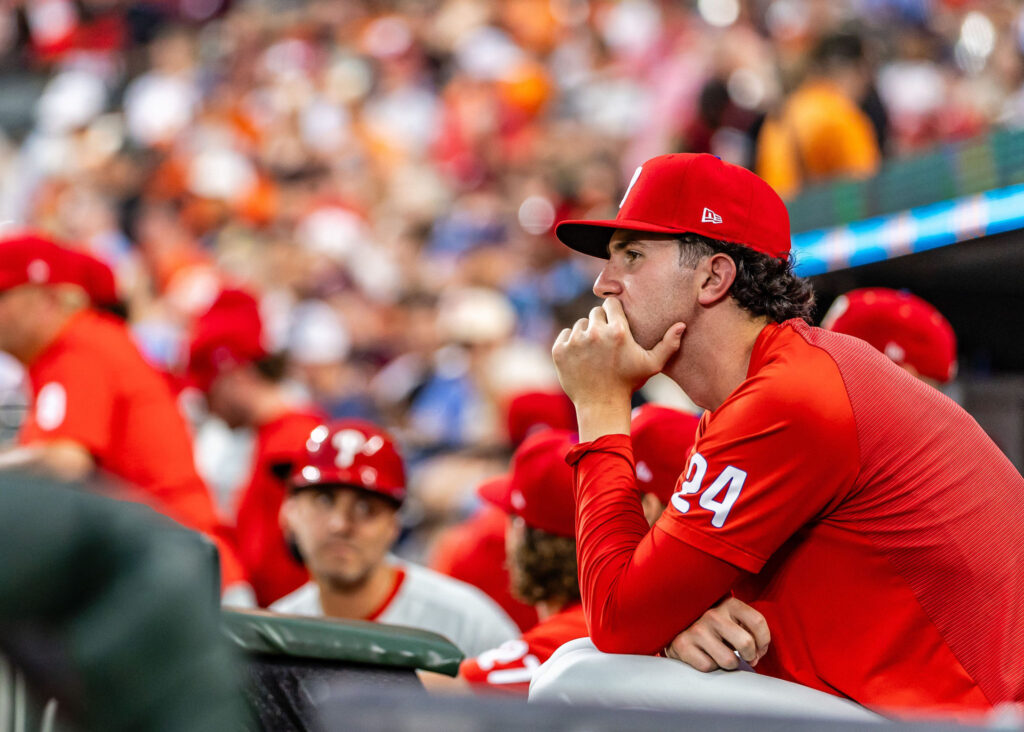
PHILADELPHIA — Andrew Painter was scheduled to take the mound for Triple-A Lehigh Valley for the sixth time in 2026 on Friday night. He got the call to report back to the Phillies and made his first big-league start since June 17 against the Orioles instead.
After a stint back in the minor leagues, the club elected to promote Painter in time for another chance before the trade deadline. The rookie bounced back from a first-inning home run to throw six innings of two-run ball in a Phillies loss to the Orioles at Camden Yards. It was a step in the right direction.
On Monday, the deadline passed, and Philadelphia did not acquire a starting pitcher. Dave Dombrowski, the team’s president of baseball operations, confirmed that Painter’s recent production played a part in that lack of an external addition.
“I think it was important,” Dombrowski said. “And not only his last start, but his two starts before that. Part of that ends up being my conversation with our staff members, too, in their comfort zone and how they feel, if he’s making the progress that they would like him to make to continue forward doing.”
Painter, a former top prospect who underwent Tommy John surgery in 2023, entered the year as the fifth starter in Philadelphia. He had some flashes, but he largely struggled. By June, it was clear that he was not keeping the Phillies in games. He was optioned for a reset and to make changes.
In five Triple-A starts, the 23-year-old right-hander posted a 4.56 ERA with 25 strikeouts and eight walks across 23 2/3 innings. But the numbers don’t tell the full story.
Painter’s ERA was inflated by seven-run outing in which he failed to make it out of the third inning on July 10. Across 21 innings in the other four games, Painter allowed just five runs and threw 67% of his pitches for strikes. He made two starts against Indianapolis in his last series in the minors — a five-inning, two-run outing and a six-inning, one-run performance. With uncertainty in the Phillies’ fifth rotation spot, Painter’s solid last two showings ultimately landed him the nod.
“He was great,” IronPigs manager Chris Adamson said about Painter’s last two starts for Lehigh Valley. “He was able to execute heaters on both sides of the plate, he was able to land and spin. But more than just the pitches himself, he just had a bit of an air of confidence about him. Seeing him walk off the field with his head held high and start to act on the things he’s been working on behind the scenes was really awesome.”
That newfound confidence was a beneficial side effect of the bevy of other adjustments Painter made at Lehigh Valley. Needing to address his velocity, command and delivery, he’s came back to Philadelphia having seen improvement at all three.
Painter’s fastball averaged 97.2 mph in Triple-A, up a tick from his 96.5 mph average in the majors before the demotion. He also reached 99 mph six times after only touching the mark once prior to being sent down. He’s put a lot more of the load on his back leg and his delivery has looked a lot more fluid since. He’s employed a circle grip on his changeup and is attacking lefties more with the sweeper. He’s ditched his splitter, which he said was “great early this year ” but “then got a little inconsistent and started cutting in.”
“I feel like not gripping a splitter 90 times a game helps the fastball a little bit,” Painter said. “I decided to stick with it and really trust that process. It took probably two or three starts to get a feel for the chain of such a fee, pitch, whereas the splitter is more of a you kind of just grip it and throw as hard as you can. So being able to get that feel back was took a little bit of time.
Above all, he’s been pounding the strike zone and getting ahead in counts early rather than trying to get hitters to chase right away. After allowing four walks on July 10, Painter surrendered just one free pass across his last two starts for the IronPigs.
“When I had success down there for those couple starts, it was walks were at a minimum, and it was in the zone early,” Painter said. “I think that just allows you to get earlier outs and just pitch deeper into those games.”
It was a rough first 14 games to start the 2021 first-round draft selection’s big league career. He had a 7.06 ERA, allowed a .404 batting average on his fastball and a .325 average to left-handed hitters. He needed to adapt, and with the help of coaching staff in Allentown, he did just that.
The results followed last week. The Phillies were pleased with how he drove toward the plate instead of spinning off. He went after major-league batters, even after slugger Pete Alonso crushed an opposite-field homer off him early.
“That outing in Baltimore was aggressive,” interim manager Don Mattingly said Wednesday. “You can see he was on the attack. The body language was good. All of that. That’s what we really need every time he gets the ball. We want him to feel like that and look like that as much as possible. We always know there’s going to be duds for anybody. … Every once in a while, you’re going to hit a bad one, but for the most part, you’d like it to be consistent.”
Questions will loom over Painter until he regularly performs well in the majors. For now, he needs to understand that he’s not pitching for his future every time he’s on the mound; the Phillies showed their belief in him to hold his own at the deadline. He’ll have the chance to show that it was the right decision starting Wednesday night against the Nationals at Citizens Bank Park. The key, as always, will be in the details.
“It’s easy for him to put an overly large amount of stock into just the results,” Adamson said, “but I think as he goes, he’s understanding the extreme importance of the day-to-day. Every time he picks up a baseball, it’s with a purpose. Hopefully that’s starting to be a bit more the norm for him in terms of not setting an unrealistically high bar and just understanding the importance of all the little things.”
— Ty Daubert and Destiny Lugardo contributed to this story.





Latest Comments